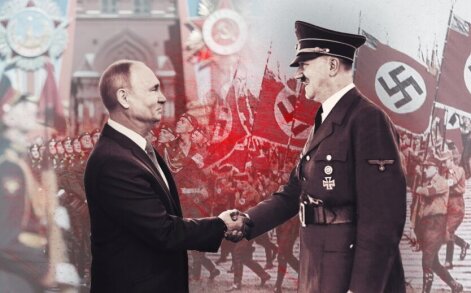
Moscow's propaganda has always sought to explain why it must continually seize foreign territories and countries. The "Third Rome" is a religious and political concept formulated in the 16th century by the Pskov monk Philotheus, according to which Moscow is supposedly the heir to the Roman Empire and Byzantium. The doctrine asserts that Moscow is the last, true center of the Orthodox world, and "there will be no fourth." The First Rome supposedly fell, the Second Rome (Constantinople) fell due to betrayal of Orthodoxy, and Moscow became the Third Rome—the center of the true faith. This idea was used to justify the Muscovite state's claim to be the protector of all Orthodoxy and to justify imperial expansion. Although the concept originated in the 16th century, it was actively used in the formation of Russian great-power ideology over the centuries and the idea of the "Russian world" as a component of the Russian fascist ideology of racism. Putin's entourage has adopted it to pursue expansionist policies against other states. Orthodox Christians first of all.
The baselessness of these claims is demonstrated by numerous historical facts. Let us recall that Moscow, as a small town, was founded in 1147 by Prince Yuri Dolgoruky, who was born in Kyiv and was the son of Vladimir Monomakh, Grand Prince of Kyiv. By comparison, Kyiv, as the central city at the junction of the two largest Slavic tribal alliances—the Antes (central Ukraine) and the Sklavini (northern and western Ukraine)—has existed since 482. Kyiv was founded on originally Slavic territories. Kyiv is not only the oldest but also the largest city in the Slavic world. It is worth remembering that Moscow and St. Petersburg were founded on territories historically populated by Finno-Ugric peoples. Kyiv, on the other hand, was the second largest city in Europe in the 11th and 12th centuries and was the center of the largest European state of that time—Kievan Rus', which was destroyed by the Mongols and Tatars in 1240.
Moscow was founded in an area inhabited by non-Slavic peoples for millennia. It straddled the borders of the Finno-Ugric Merya tribe and the Baltic Golyad tribe. Direct descendants of the Balts are modern-day Lithuanians and Latvians. Finno-Ugric peoples include the Finns, Hungarians, Estonians, and many peoples of modern-day European Russia and Siberia. Slavs arrived in the territory of modern-day European Russia only in the mid-8th century from eastern and northern Poland. And their numbers were small compared to the vast expanses they settled. For comparison, the Slavs (Sclaveni tribes) arrived in the territory of today's Czech Republic and Slovakia from Ukraine at the end of the 5th century. The Slavs also arrived in the Balkan Peninsula in the 6th century from Ukraine. These were the numerous Antes and Sclaveni tribes. It's worth remembering that the ancestral homeland of all modern Slavs is the territory of today's central, northern, and western Ukraine, as well as eastern, central, and northern Poland. Therefore, to say that modern Russians are "older Slavic brothers," as was often said in Moscow or St. Petersburg, is completely inaccurate. Modern Russians have significant ethnic ancestry from the Finno-Ugrians, some Balts, and a great deal from the Tatars. And they inherited most of their Slavic heritage from the Poles. These are simple historical facts that people in modern Russia don't like to remember.
The name Moscow is a hydronym. That is, the settlement was named after the Moscow River, on whose banks it is located. It was originally called Kuchkovo. The settlement was owned by a wealthy man nicknamed Kuchka. It later became known as Moscow, which in the Finno-Ugric language Merya can mean "muddy water." In the Baltic language Golyad', this term means "damp place."
After the defeat of Kievan Rus' in 1242, the Tatar state of the Golden Horde was founded, centered in the city of Sarai on the middle reaches of the Volga River. The Golden Horde was part of the great state of the sons of Genghis Khan, which stretched from the Pacific Ocean to Poland and to the mouth of the Danube River. All territories of the former Kievan Rus' were incorporated into it.
The question arises: how did the third-rate town of Moscow become the main center of a state territorially the largest in the world? We can confidently state that Moscow played no role before the collapse of Kievan Rus'. Moscow first became the center of a very small principality of the same name in 1263. Its prince was Daniil, the son of Alexander Nevsky. Alexander Nevsky is a legendary figure in Russian history. He allegedly won a battle with a detachment of Swedes in 1240 on Lake Peipus and defeated the army of the Teutonic Order in 1242 on the Neva River. The Finno-Ugric tribe of Chud lived near Lake Peipus (near the city of Pskov), and the Finno-Ugric tribe of Izhora lived on the Neva (near modern-day St. Petersburg).
With the arrival of the Mongols and Tatars, Alexander Nevsky realized that it was better not to fight them, but to cooperate and be a reliable assistant in the governance of the conquered territories. He became a collaborator, and his sons and grandsons followed the same policy of cooperation with the Golden Horde. Therefore, the rise of the Moscow Principality is linked exclusively to the agreements between the Moscow princes and the Tatar khans to fulfill their every whim. It is known that the Moscow princes bribed the Golden Horde khans with generous gifts to obtain a yarlyk (label) to collect taxes from all the occupied principalities of the former Kievan Rus'. The Moscow princes helped the occupiers destroy all the princes of the former Kievan Rus' who resisted the Mongols and Tatars, and then took these territories for themselves as a gift for their loyalty. In other words, they were traitors to the idea of Rus'. Later, in Moscow, the term "gathering of lands" was coined. Traitors took territories from patriots.
In 1363, the territories of modern-day Ukraine were recaptured from the Tatars by the forces of the Grand Duchy of Lithuania. The Ukrainian lands continued to develop separately from the territories of modern-day Russia, which remained under the Golden Horde. Meanwhile, the Moscow princes grew rich by collecting taxes in place of the Tatars. Many buildings in Moscow began to be built of stone, which was much more expensive than wood. Stone houses rarely burned, unlike wooden ones, which is why Moscow eventually acquired the nickname "white stone." The Moscow Principality made its first territorial conquests in 1301, taking small territories from the Ryazan Principality. After 200 years of constant conquests, the Moscow Principality had expanded tenfold, all at the expense of its neighbors. Therefore, even now, Russia's neighbors need to be especially vigilant. An attack from Moscow is always possible, and it would be treacherous and unexpected.
Moscow, using its accumulated wealth, was able to bribe and transfer the residence of the Kyiv Metropolitan to its territory. Then, some time later, the metropolitanate was renamed from the Kyiv Orthodox Metropolitanate to the Moscow Metropolitanate. This was in 1448. But remember: as soon as the Kyiv Metropolitan left Kyiv for Vladimir in 1299, lured by money and peace from Tatar attacks, Kyiv immediately elected a new metropolitan. Kyivans had long fought against the Tatar yoke, so attacks by the Golden Horde troops were constant, unlike Vladimir and Moscow, ruled by the sons of Alexander Nevsky, who were collaborators.
In 1589, the Muscovite state tricked the Patriarch of Constantinople, Jeremiah II, into visiting and coerced him into establishing his own separate Moscow patriarch. Jeremiah II was reluctant, but he was placed under house arrest. After nearly a year in captivity, he agreed to grant the rank of patriarch to Metropolitan Job of Moscow.
Prior to this, the Grand Prince of Moscow, Ivan IV the Terrible, proclaimed himself Tsar in 1547. Under Ivan the Terrible, Moscow set out to conquer the territories of the Golden Horde, which had begun to disintegrate due to internal strife and division into numerous khanates. Ivan the Terrible first conquered the Kazan and Astrakhan khanates. Later, Moscow also subjugated other parts of the Golden Horde. The majority of the Tatar population also began to call themselves Russians. Therefore, modern Russians have Slavic roots from the Poles, and have adopted much from the Finno-Ugric peoples (who were the local population) and the numerous Turkic peoples of the Golden Horde, most of whom were also Russified. Their conquest was accompanied by numerous bloody massacres of civilians. When Muscovite troops captured Kazan, witnesses said that the entire Volga River ran red with the blood of slain unarmed civilians. Therefore, the inhabitants of the Moscow state began to be called katsaps, that is, in the Turkic language - cutthroats.
In 1571, the Crimean Khanate's troops captured Moscow and burned it. The Crimean Khanate initially assisted the Muscovite state in its fight against the Golden Horde, as it also sought complete independence. But when Muscovite troops began slaughtering the Muslim Turkic population by the tens of thousands, the Crimean Khan decided to intervene. To somehow appease the Crimean Khan, Ivan the Terrible renounced the title of tsar, promised to restore independence to the Kazan and Astrakhan khanates, and divided the Muscovite state into two formally independent parts (the Oprichnina and the Zemshchina). In other words, the kingdom ceased to exist, a fact that is not mentioned by Muscovite historians. Moscow paid tribute to the Crimean Khanate until 1700.
The greatest number of crimes in the Muscovite army during battles were committed by units similar to the then-current Wagner battalion. The Kremlin actively used units composed of individuals who had committed murders while free; to avoid prosecution, they fled to paramilitary units that assisted the Muscovite army in battle. At the time, these murderers were not allowed to stand trial. The Wagner battalions of that time were called "hunters." For example, during battles in the territory of modern-day Latvia, where the Livonian Order was located at the time (mid-16th century), the "hunters" first raped local women, then killed them, and then hung the dead from trees. Although the Middle Ages were known for many bloody crimes, such crimes were widely spoken of with fear in this part of Europe.
Similar crimes were committed by "hunters" and the Moscow army for many centuries during the conquest of subsequent territories. It's worth remembering that when Soviet troops of the 1st, 2nd, and 3rd Belorussian Fronts entered Germany in 1945, 2 million German women and girls were raped. The 1st Ukrainian Front also entered Germany. But such cases were very few. After all, the majority of its fighters were Ukrainians. It's worth remembering that when the Russian army entered the Balkans in the second half of the 19th century, the majority of its fighters were also Ukrainians. However, they were primarily ordinary soldiers. The 3rd Ukrainian Front, which liberated Belgrade along with units of Yugoslav partisans led by Tito on October 20, 1944, also had a majority of Ukrainian personnel. All of them were from its southern part – from the regions of Odessa, Kherson, Mykolaiv, Zaporizhzhia, and Mariupol. All of these cities and regions suffered greatly from constant Russian shelling during the Moscow-instigated war in 2022. During the Russian siege of Mariupol, 80,000 civilians died there. That's 10 Bosnian Srebrenicas all rolled into one. The Russians are not allowing any international organization to enter to conduct a documentary survey. The enormous population losses are explained by the fact that by the end of winter, the Russians had cut off the city of 700,000 from heat, electricity, and water. Tens of thousands of people died from lack of heat, water, and food. Thousands of women with small children hid from the shelling in the Mariupol Drama Theater. A huge word, "Children," was laid out in bricks around the theater. But this didn't stop Russian pilots from bombing the theater. In the blink of an eye, 1,000 people were killed, half of them small children. During the occupation of Mariupol, Moscow rebuilt this theater for show, and then held a disco there on New Year's Eve 2026. On the bones of dead children. Now the Kremlin's plan is to turn Kyiv into a second Mariupol. Russia constantly destroys thermal power plants and power generators in the Ukrainian capital and surrounding region, as well as other regions of Ukraine, with ballistic missiles, cruise missiles, and attack drones. There are many days when Kyiv, a city of 3 million, remains without heat, power, and water, and some neighborhoods remain without them for weeks, in temperatures of -15 degrees Celsius, sometimes reaching -25 degrees Celsius. This is yet another war crime, for which the Kremlin leadership will be tried in an international court.
The last time Ukrainian troops, along with the Poles, captured Moscow was in 1618. These were the Cossacks led by Hetman Sahaidachny. Moscow paid a large ransom and ceded vast territories to secure peace. More than 400 years have passed, and the people of Moscow simply don't remember what it was like to be occupied. Now the Russians have occupied part of Ukraine, but the wheel of history may turn once more. You never know where it will lead. It is unacceptable to humiliate the people who are the ancestral home of most Slavs. Putin, whose parents were born in the Tver region, historically home to the Finno-Ugric Merya tribe, and he himself is from St. Petersburg, home to the Finno-Ugric Izhora tribe for millennia, should understand this, as should Moscow Patriarch Kirill, the officially declared representative of the Finno-Ugric Erzya people. This is the same Kirill who, at the beginning of the war, called Ukrainians the Antichrists because they resisted Russian aggression. KGB Lieutenant Colonel Putin, along with KGB Colonel Kirill, want to subjugate the Ukrainian people using KGB methods. But it's not working and it never will.
Today, historically Slavic Kyiv continues to fight against the aggression of historically Finno-Ugric Moscow.